One-Point Perspective
Introduction
One-point perspective is when an object is directly in front of an observer
and not seen at an angle. The principal surface of an object is parallel to the
picture plane and to the station point. The remaining structure of the object
is perpendicular to the picture plane. For this reason, one-point perspective
is also called parallel perspective. One of the most common uses of one-
point perspective is in interior architectural illustrations. For interesting
study on one-point perspective, study tromp-l’œil drawings and paintings.
One-point or
parallel
perspective
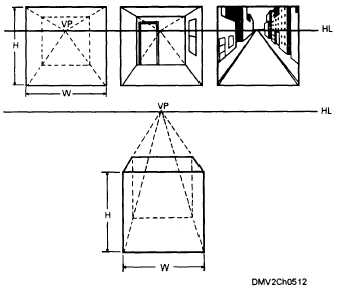
One-point or parallel perspective places two principal edges (height and
width) of one surface of an object parallel to the picture plane. Height and
width have no vanishing point and appear in true length since they are
parallel to the picture plane. Only the depth dimension must be put in
perspective, and this requires one vanishing point. The station point is in
front and parallel to the object and the vanishing point is directly behind. To
find the third dimension representing depth, project visual rays from the
station point to the vanishing point. Changing the location of the vanishing
point or raising and lowering the eye level affect perspective.
Figure 5-12 shows one-point perspective with vanishing points behind and
above the cube or object.
Figure 5-12.—One-point perspective.
5-13